
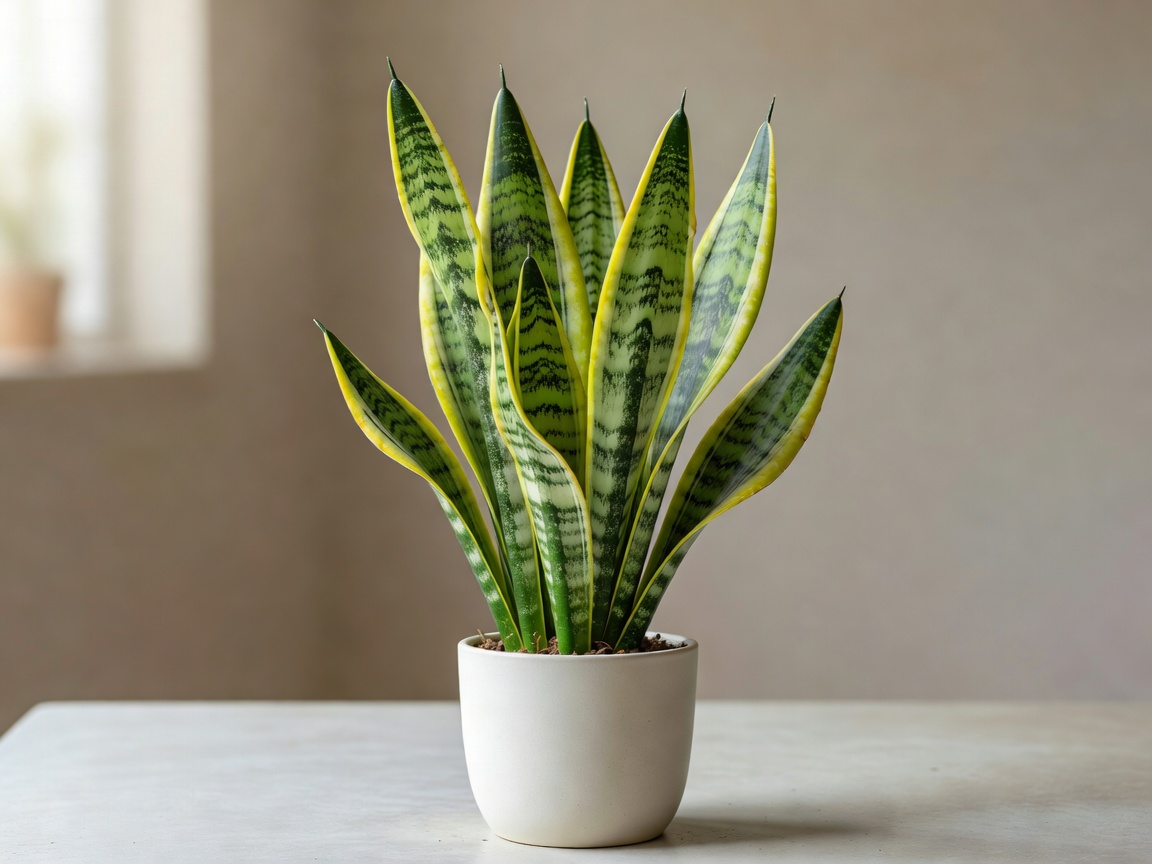
1. Taxonomy & Evolutionary Adaptations
Formerly classified under the independent genus Sansevieria, genetic sequencing has reclassified this hardy botanical under Dracaena trifasciata. Native to tropical West Africa from Nigeria east to the Congo, it has evolved in rocky, dry terrains where rainfall is sporadic and fierce sun threatens plant tissues.
To thrive under extreme water stress, the snake plant employs Crassulacean Acid Metabolism (CAM). During the scorching daylight, its stomata remain tightly closed to prevent transpirational water loss. At night, when temperatures fall, the stomata open to absorb carbon dioxide, which is stored as malic acid until daylight powers photosynthesis.
Common Pitfall: Overwatering in Winter
The single fastest way to kill a snake plant is frequent watering during cold, dim winter months. In low light, water consumption drops close to zero. Water only once every 4 to 6 weeks in winter, allowing the gritty substrate to dry out entirely between waterings.
2. Substrate Physics: Gritty, Insoluble Minerals
Standard peat substrates hold moisture too long for Sansevieria rhizomes. We advise potting in a mineral-heavy succulent mix:
- 50% Pumice or Coarse Perlite (aeration and rapid drainage).
- 30% Coarse Horticultural Sand or Crushed Granite.
- 20% Quality sifted potting soil or worm casting residue.
3. Division vs. Leaf Cutting Propagation
When propagating variegated cultivars such as 'Laurentii' (with yellow margins), always propagate by rhizome division. Propagating via horizontal leaf cuttings in soil or water causes the plant to lose its golden variegation, reverting to the plain green wild-type coloration due to chimera cell genetics.
Authoritative Taxonomic Resource
View phylogenetic classification data: