
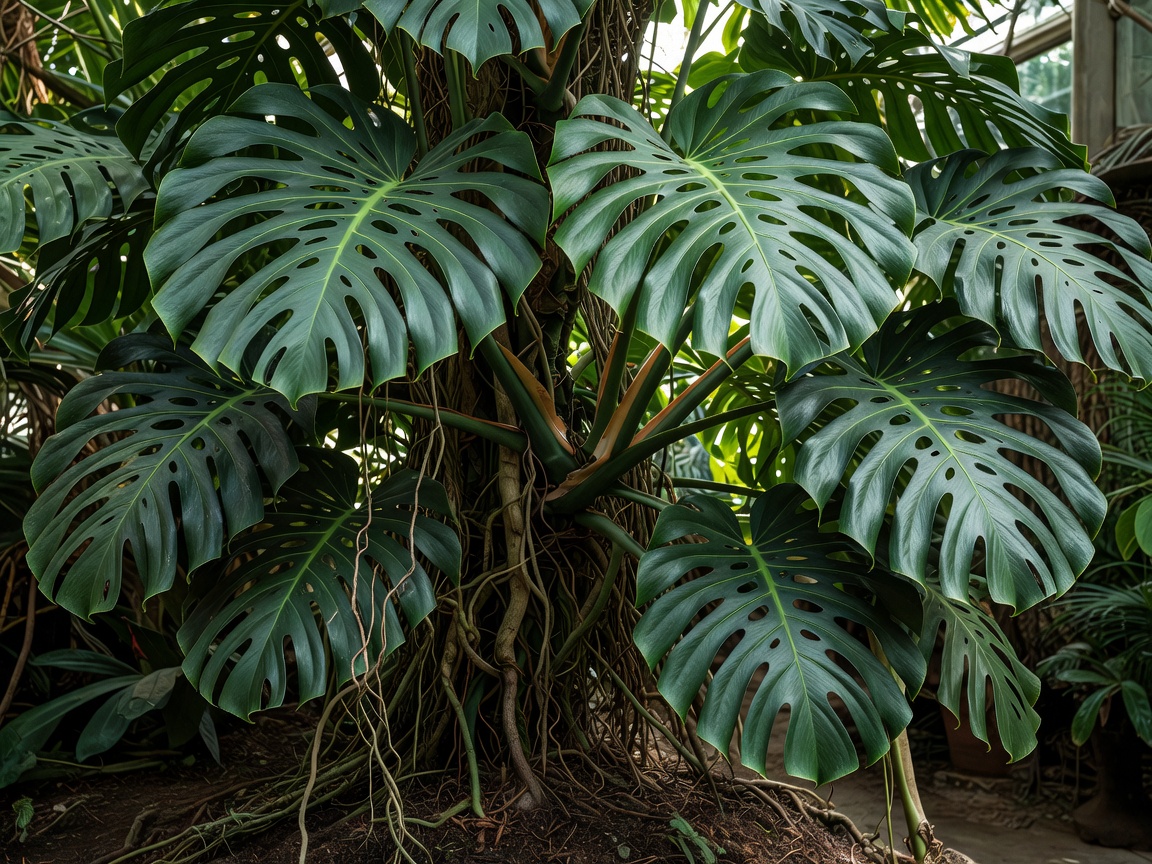
1. Native Ecological Origins & Morphology
Monstera deliciosa is native to the wet tropical forests of southern Mexico and Central America, ranging from Veracruz down into Panama. In its wild habitat, the plant begins its life on the forest floor, exhibiting strong skototropism (growth directed toward dark silhouettes of massive forest trees) before ascending trunks as a hemiepiphyte.
The characteristic leaf slits and perforations—botanically classified as fenestrations—serve evolutionary purposes: they allow dappled sunlight to penetrate lower leaves in dense forest canopies and minimize the risk of hurricane-force winds tearing the wide leaf lamina.
Horticultural Tip: Triggering Fenestrations
Juvenile Monstera leaves remain entirely solid. Slits only emerge when the plant receives adequate foot-candles of light (minimum 400–600 FC of bright, indirect illumination) and has a sturdy vertical totem—such as a moist sphagnum moss pole—for its aerial adventitious roots to grip.
2. Substrate Physics: Why Dense Potting Soil Kills Aroids
Standard store-bought houseplant soil composed predominantly of peat moss and fine sand compacts quickly under repeated watering. In rainforest canopies, Monstera roots are exposed to continuous airflow and loose leaf debris. When placed in waterlogged soil, the oxygen pore space collapses, precipitating deadly fungal Pythium and Phytophthora infections (root rot).
We recommend our signature chunky aroid soil formula:
- 40% Coarse Douglas Fir Bark or Orchid Bark: Provides structural oxygen pockets that never compact.
- 25% Organic Coco Coir Chunk: Holds balanced moisture without suffocating the roots.
- 15% Coarse Horticultural Perlite: Maintains aerated porosity throughout multiple wet-dry cycles.
- 10% Activated Horticultural Charcoal: Acts as an anti-microbial sponge, neutralizing metabolic toxins.
- 10% Worm Castings: Delivers gentle, slow-release bio-available micronutrients.
3. Hydration Cycles & Moisture Testing
Never water on a rigid calendar. Instead, gauge moisture by inserting a wooden skewer or digital moisture probe 3–4 inches into the root ball. Hydrate only when the top 50–70% of the substrate is completely dry. When watering, saturate the container thoroughly until at least 20% drain out from the base holes, carrying away residual fertilizer salts.
4. Managing Aerial Roots & Moss Poles
As your Monstera matures, long brown adventitious aerial roots will shoot out from leaf nodes. You should never cut healthy aerial roots. Instead, gently train them downward into the pot's substrate or wrap them onto an active sphagnum moss pole to supply supplemental moisture directly to higher foliage.
Official Reference Links & Taxonomy
Verify taxonomic classification at authoritative international databases: